






IBCS Certified Analyst/Professional
ISO 24896 foundation and IBCS composition of compelling reports
(in-house)
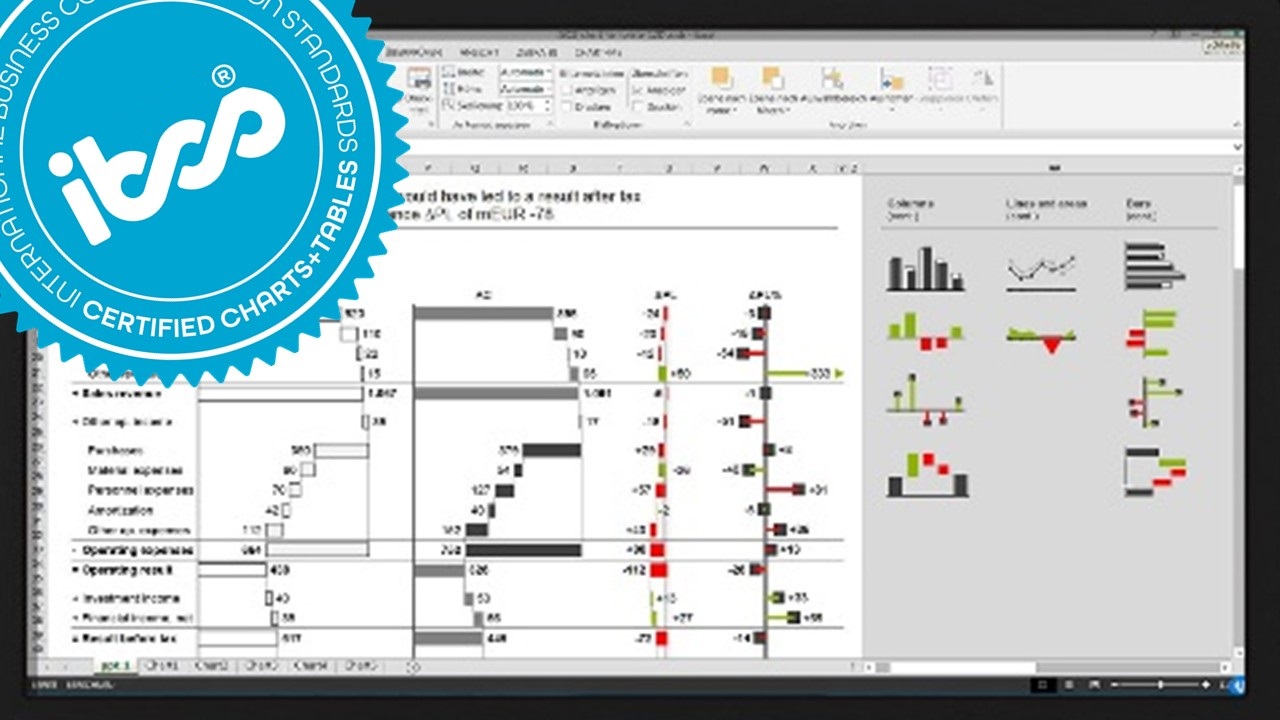
What makes reports, presentations, and dashboards faster and better understandable? Learn the difference between reporting designed to support analysis and reporting intended to communicate messages. Both require consistent ISO 24896 notation and compelling composition, which can be achieved by applying the SUCCESS formula of IBCS . With numerous examples and hands-on exercises, we prepare you for practical application. Optional online-test and IBCS Certified Analyst/Professional certificate.

















PROGRAM
Introduction: The basics of business communication
- Reports and dashboards: Analysis or message conveyance?
- Decision support by Artificial Intelligence
- Notation, composition and the SUCCESS formula of IBCS
Use a standard notation
- ISO 24896 notation for business reporting
SIMPLIFY: Avoid clutter
- Avoid noise and redundancies
- Exercise: Simplify a table
UNIFY: Apply semantic notation
- Unify terminology and visualization
- Exercise: Create a chart in semantic notation
CHECK: Ensure visual integrity
- Check proper scaling
- Exercise: Scale an indexed line chart
Apply ISO 24896 notation for business reporting
- Create Mindmaps for SIMPLIFY, UNIFY and CHECK
- Group exercise: Create a chart in ISO 24896 notation
- Why you need a notation manual and what it should include
- Support from ISO 24896-compliant software and templates
Compose compelling reporting
- Storytelling based on a consistent notation
SAY: Convey a message
- Detect, explain, or suggest
STRUCTURE: Organize content
- Use homogeneous, non-overlapping and exhaustive elements
EXPRESS: Choose proper visualization
- Use correct chart type
CONDENSE: Increase information density
- Add data, components, and visuals
Group exercise: Compose a compelling report
- Mindmaps for SAY, STRUCTURE, EXPRESS, and CONDENSE
- Case studies in financial and human resources reporting
- Presentation of the results
Closing discussion and next steps
- Company-wide improvement in composition and storytelling
- Data Governance and Artificial Intelligence in reporting
- Preview of IBCS Certified Analyst/Professional exam
Breaks
With classroom courses there is a lunch break of one hour at 12:30 and two coffee breaks in the morning and in the afternoon.
In the case of online courses, break times can be arranged individually.