









Iwona Stasiak
Independent Finance & Reporting Consultant specializing in IBCS principles management reporting, FP&A transformation, planning processes and governance. Supports companies in structuring planning cycles, harmonizing management information and building transparent reporting frameworks that drive clarity, confident decisions and strong operational performance.
About
I am a Senior Finance Leader and IBCS Certified Consultant with extensive experience in FP&A, controlling, governance and finance transformation across international and matrix organizations. I design and implement IBCS‑compliant reporting frameworks, streamline planning cycles and harmonize management information to support clear, consistent and decision‑ready communication. I have built and led finance teams, managed post‑acquisition integration, implemented governance and risk frameworks, and delivered reporting transformations that improve transparency, data quality and business performance. My work focuses on turning complex financial information into actionable insights that enable confident, well‑informed decisions.

IBCS® Certified Consultant
Iwona Stasiak has successfully completed the IBCS® certification for successful design of reports and presentations at the IBCS Institute in May 2026.
Work sample 1
These work samples are selected from an 18‑slide redesign of ORLEN’s Q4 2025 financial results presentation. The examples illustrate how I applied IBCS standards to restructure EBITDA LIFO reporting, unify chart notation and enhance the clarity and comparability of segment performance. The slides demonstrate how consistent visual language and focused storytelling support transparent communication and better decision‑making.
-
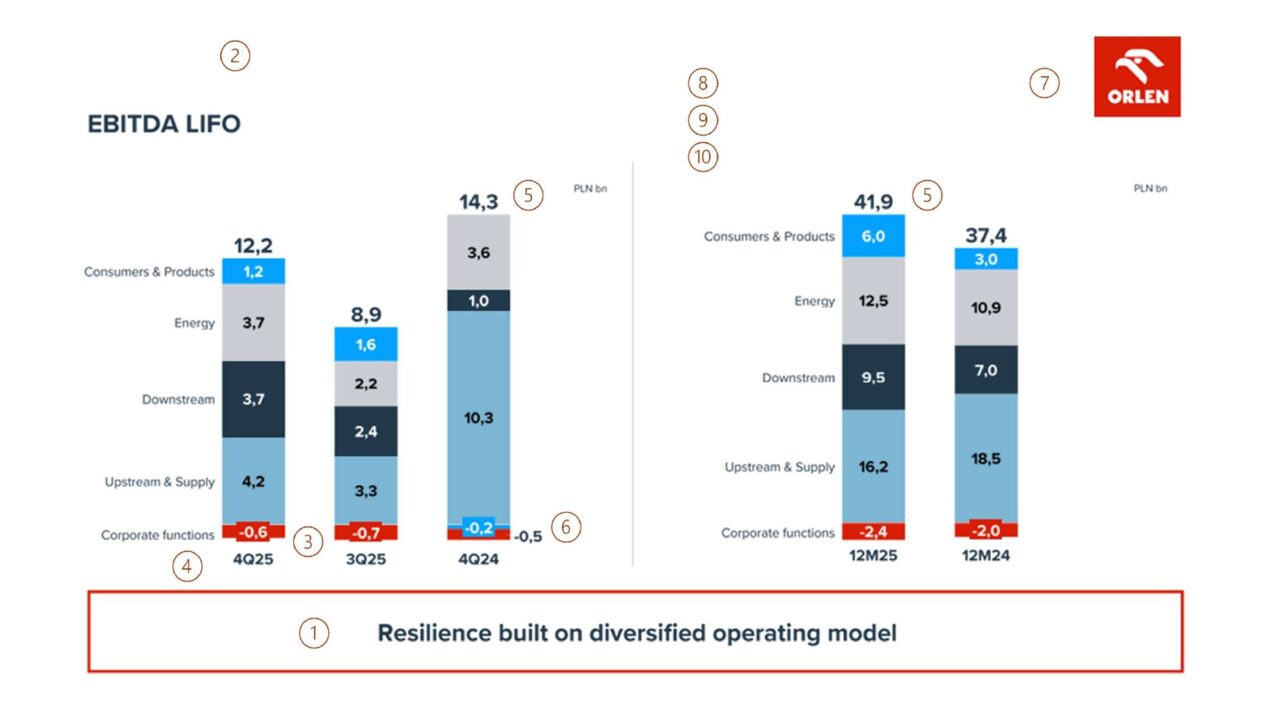
Slide 1 This slide shows the original version of one of the 18 pages from ORLEN’s Q4 2025 results presentation. The intended message — “Resilience built on a diversified operating model” — is present, but the visual structure makes it harder to see how segment volatility translates into stability at Group level. Using IBCS principles, I identified where the design could be simplified, the message clarified and the visual noise replaced with information that supports faster, clearer interpretation.
-
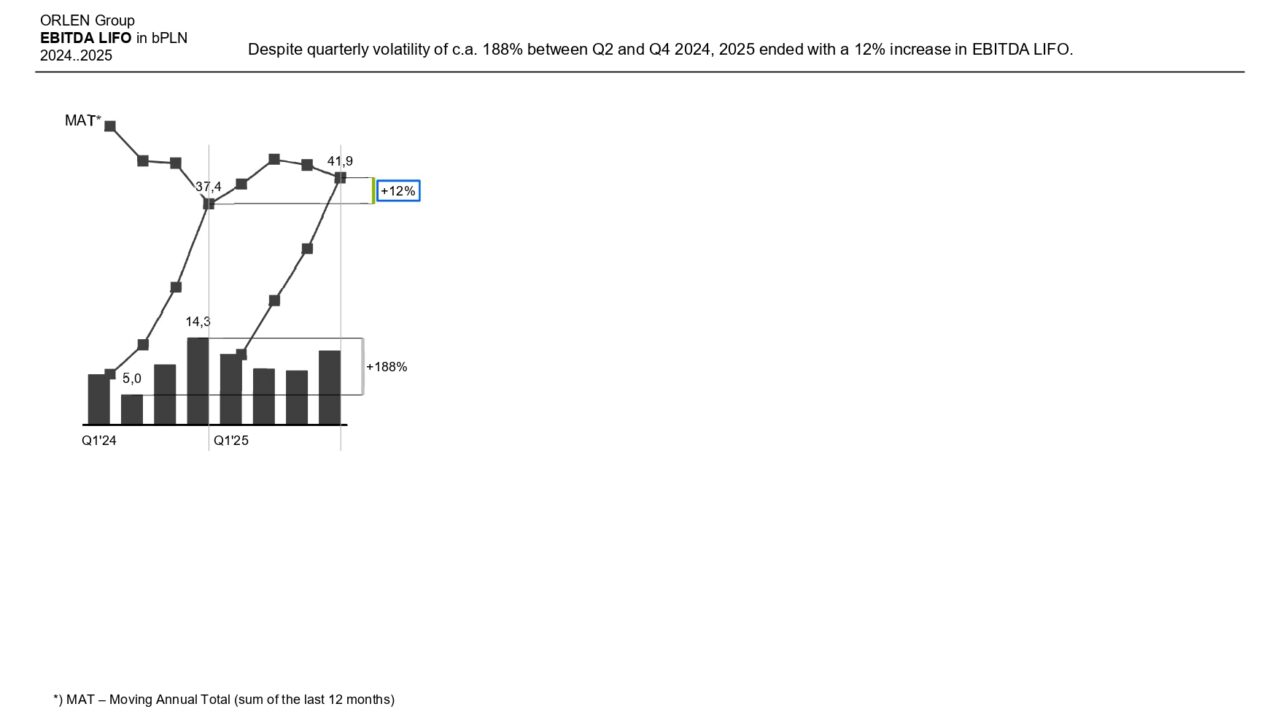
Slide 2 This slide presents an IBCS compliant Z chart showing ORLEN’s quarterly EBITDA LIFO together with the Moving Annual Total. The redesign highlights how short term volatility contrasts with the stable long term trend, making the +12% MAT increase easy to see at a glance. By structuring the data clearly and reducing visual noise, the chart helps the viewer understand the relationship between quarterly fluctuations and overall performance. Applied IBCS principles: – Clear message and descriptive title placed at the top (UNIFY). – Consistent typography and simplified color scheme (UNIFY). – Removal of non informative elements and reduction of visual noise (CONDENSE). – Corrected timeline direction and harmonized scales (UNIFY). – Appropriate chart selection for the data structure (CHECK). – Standard Z chart structure combining period values and MAT (UNIFY). – Reduced color palette and simplified labeling (CONDENSE).
-
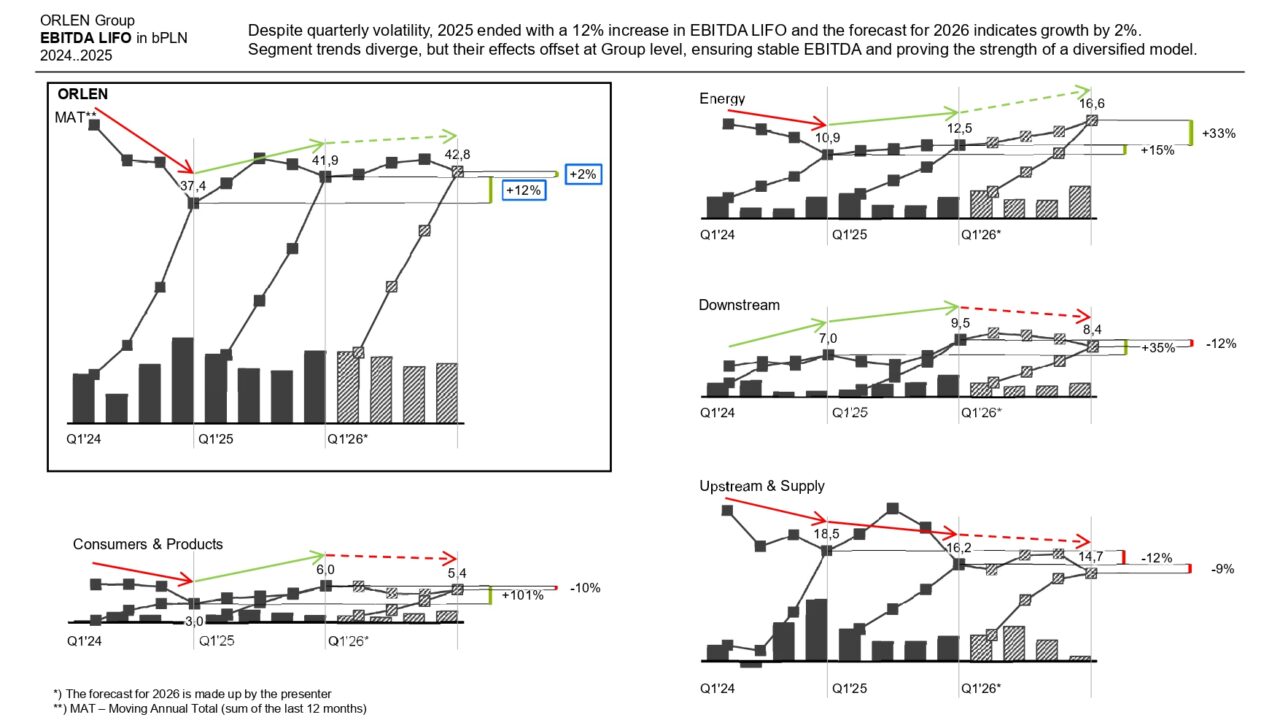
Slide 3 This slide extends the Z chart by adding segment level results, a 2026 forecast and clear trend indicators. By saving space through consistent IBCS structuring, it becomes possible to show how declines in some segments are offset by growth in others, making the message “Resilience built on a diversified operating model” visible at a glance. The unified layout highlights segment dynamics, deviations and the stabilizing effect they create at Group level. Applied IBCS principles: – Consistent layout enabling multiple segment views on one page (UNIFY). – Harmonized scales and consistent axis notation (UNIFY). – Clear separation of actuals vs. forecast (UNIFY). – Trend arrows and deviation indicators applied consistently (UNIFY). – Space saved through standardization used to add meaningful information (CONDENSE).
-
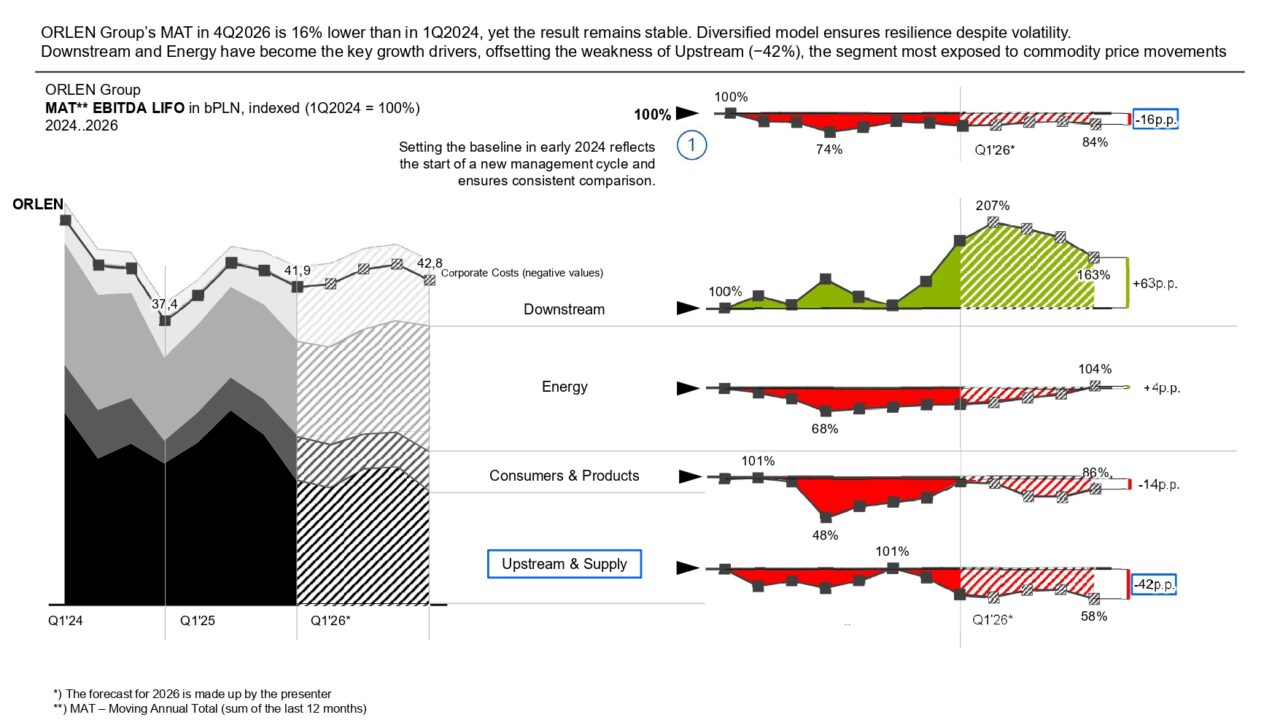
Slide 4 This slide introduces an indexed MAT view to show how each segment contributes to the Group result and how their performance has changed since the management transition in 2024. By standardizing the baseline and applying IBCS notation, it becomes easy to see which segments strengthened the Group’s resilience and which require more attention. The clear structure highlights relative dynamics, supports comparison across segments and helps explain the diversified model behind the overall stability. Applied IBCS principles: – Indexed baseline enabling relative comparison across segments (COMPARE). – Harmonized scales and unified chart structure (UNIFY). – Highlighting segment contributions and performance shifts (HIGHLIGHT). – Removal of decorative elements to focus on insight (CONDENSE).
Work sample 2
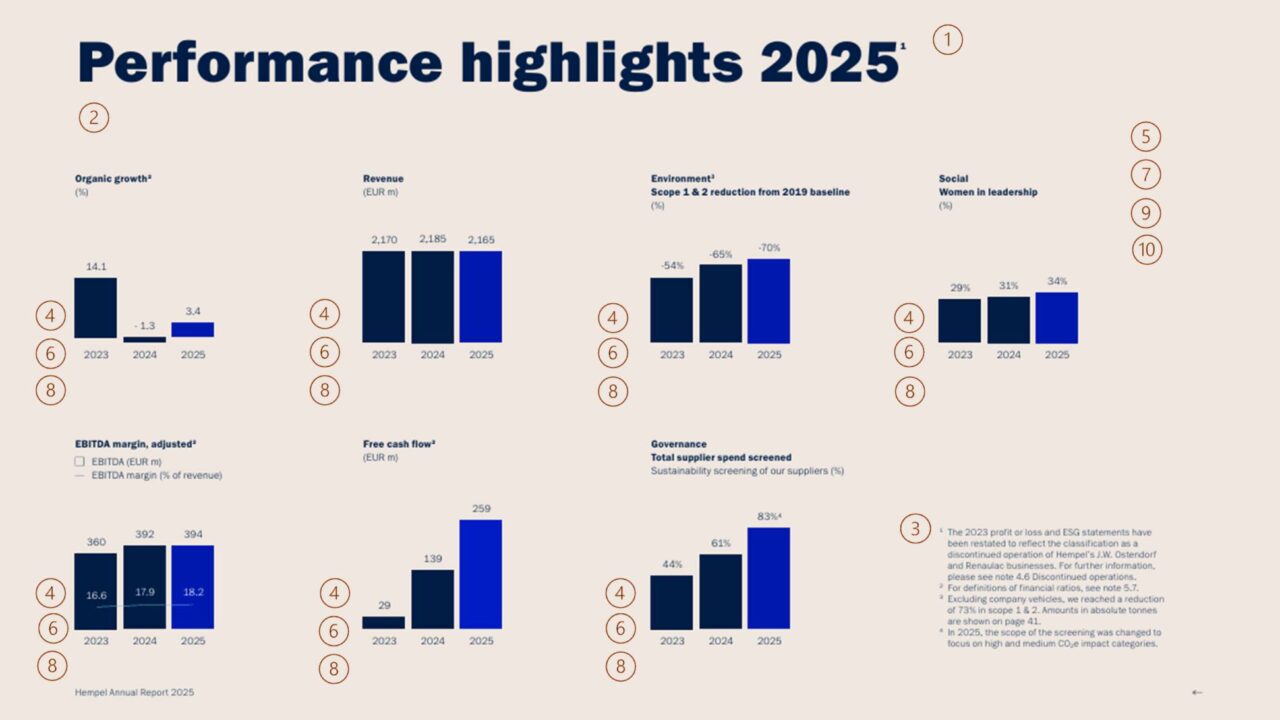
This is the second set of my work samples and is based on selected pages from Hempel’s 2025 Annual Report. The redesigns illustrate how I applied IBCS standards to different types of strategic communication — from KPI overviews to performance narratives — using my own interpretation of the publicly available data. By simplifying the visuals, unifying structures and focusing on the key messages, the redesigned pages show how IBCS can clarify trends, highlight priorities and support transparent communication at the strategic level.
-
Slide 1 This slide shows the original version of one of the 18 pages from ORLEN’s Q4 2025 results presentation. The intended message — “Resilience built on a diversified operating model” — is present, but the visual structure makes it harder to see how segment volatility translates into stability at Group level. Using IBCS principles, I identified where the design could be simplified, the message clarified and the visual noise replaced with information that supports faster, clearer interpretation.
-
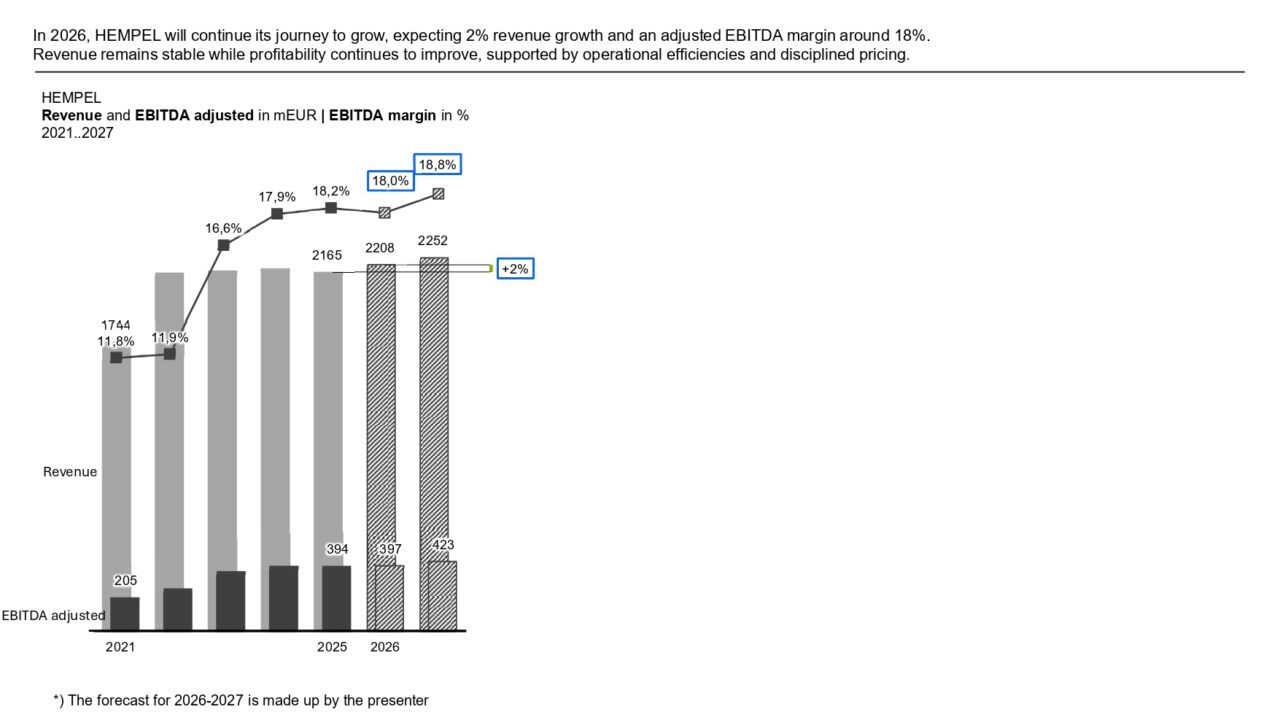
Slide 2 This slide combines revenue, adjusted EBITDA and EBITDA margin into a single IBCS compliant chart. By unifying the scales and merging two separate visuals into one, the redesigned layout saves space and allows the full five year history to be shown together with a two year forecast. This structure makes it easier to see the relationship between growth, profitability and margin development over time. Applied IBCS principles: – Clear message and descriptive title added to provide context (UNIFY). – Removal of decorative elements and unnecessary colors (CONDENSE). – Use of appropriate chart forms for base metrics vs. ratios (CHECK). – One unified chart structure for related KPIs (UNIFY). – Harmonized scales and consistent axis notation (UNIFY). – Extended timeline enabled by efficient use of space (CONDENSE). – Clear distinction between historical data and forecast (UNIFY).
-
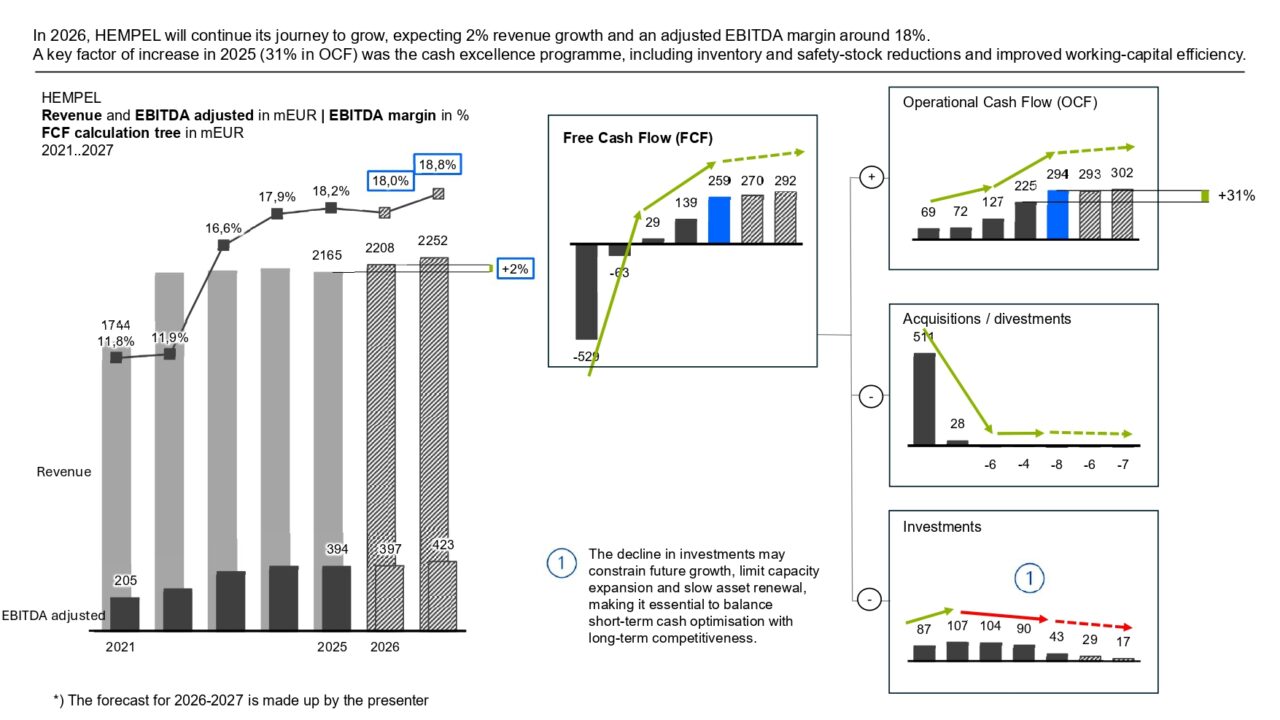
Slide 3 This slide presents an IBCS compliant FCF bridge enriched with additional historical years and a two year forecast. The redesign highlights the impact of the 2022 acquisition on EBITDA and shows how the improvement in free cash flow is partly driven by declining investments. Trend arrows make it easy to see which elements strengthen performance and where potential risks emerge, providing a clearer narrative behind Hempel’s recent financial development. Applied IBCS principles: – Free cash flow bridge structured according to IBCS waterfall rules (STRUCTURE). – Harmonized scales and consistent notation across all components (UNIFY). – Clear distinction between historical values and forecast (UNIFY). – Trend arrows and deviation indicators applied consistently (HIGHLIGHT). – Efficient use of space enabling additional years and forecast to be included (CONDENSE). – Consistent layout enabling multiple segment views on one page (UNIFY).
-
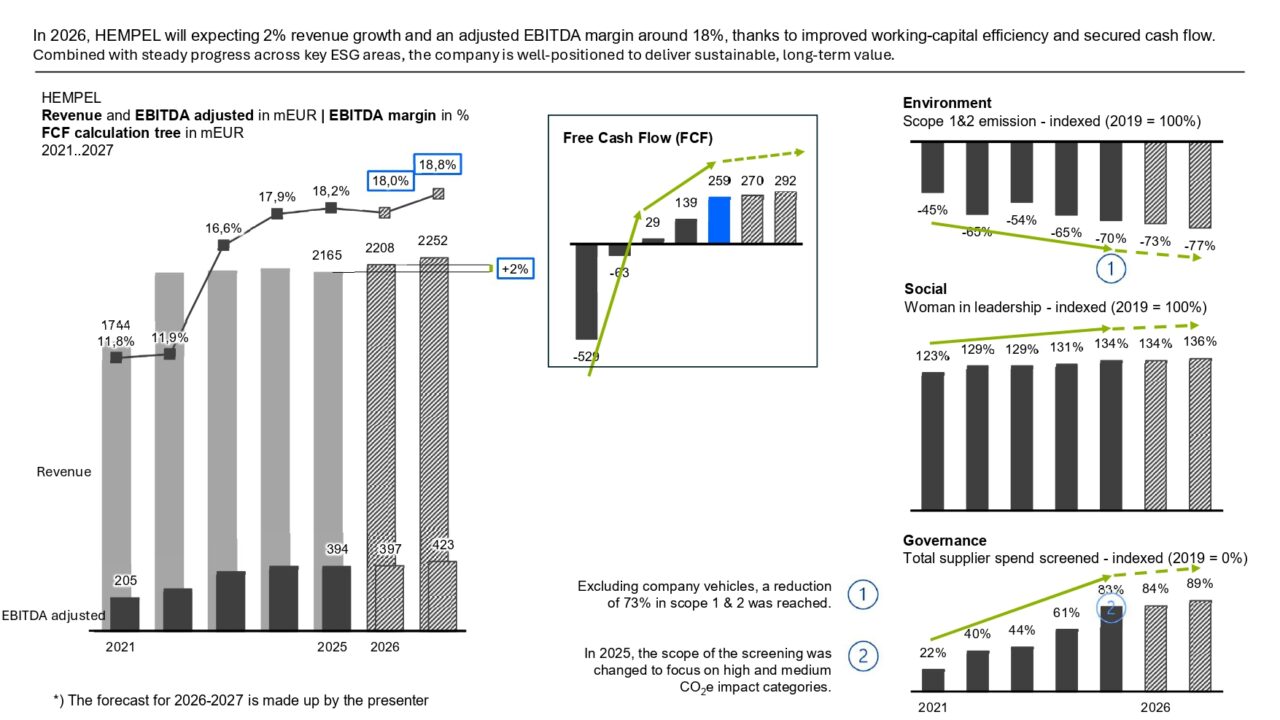
Slide 4 This slide adds a set of ESG KPIs presented in a unified, IBCS compliant structure. By extending the timeline with two additional years and a forecast, and by marking trends with arrows, the redesign makes it easier to see how Hempel’s sustainability indicators are developing over time. The commentary is directly linked to each visual. Applied IBCS principles: – Clear separation of ESG KPIs from financial metrics to create a logical structure (STRUCTURE). – Harmonized chart layouts and consistent axis notation across all indicators (UNIFY). – Trend arrows and concise comments directly linked to the visuals (HIGHLIGHT + EXPLAIN). – Extended timeline and forecast enabled by efficient use of space (CONDENSE). – Simplified color scheme and removal of decorative elements to focus on insight (CONDENSE). – Appropriate chart types selected for ratios vs. absolute indicators (CHECK).