









Arne-Kristian Schulz
As Associate Partner at Blueforte, Arne-Kristian Schulz helps shape the evolution of business communication and data-driven management. As co-author of IBCS studies, he contributes to advancing modern reporting standards.
About
Arne-Kristian Schulz is one of the influential voices in standardized reporting and data-driven management. As Associate Partner at Blueforte and Managing Director Product Management at IBCS, he combines strategic consulting with the advancement of standards and new perspectives on how organizations use data and AI to manage performance and make decisions.
His work sits at the intersection of reporting, decision logic and technological development. As co-author and coordinator of IBCS studies, speaker and specialist author, he contributes this perspective to the broader development of the field, extending well beyond individual client engagements.
HIS CONTRIBUTION
Arne advances reporting where corporate management, standards and new technological capabilities converge.
At the core of his work is the question of how reporting can continue to provide direction and support effective leadership as conditions evolve. He combines standardized data communication with new capabilities in analytics and AI, developing approaches to management that remain consistent, comparable and adaptable.
HIS PERSPECTIVE ON REPORTING
For Arne, reporting starts with the decision, not the data.
What information matters is determined by the business question and the context in which a decision is made. Only then do information architecture, visualization and interaction come into play. Arne combines this perspective with insights from cognitive and decision psychology, translating them into a reporting logic that reduces complexity and directs attention to what matters most.
He therefore sees reporting as part of an organization’s management architecture: it shapes how information is perceived, interpreted and ultimately translated into decisions.
ADVANCING IBCS
Arne has been actively involved in the evolution of IBCS for many years. As Managing Director Product Management, he brings his experience from consulting, research and corporate practice directly into the continued development of the standard.
As co-author and coordinator of IBCS studies, he complements this role with an empirical perspective on the impact of standardized data communication and the evolving requirements of modern reporting.
His work thus creates a close link between standards development, corporate practice and the question of how reporting can continue to provide orientation and comparability in the future.
SPEAKER AND AUTHOR
Arne regularly contributes his perspective to the professional discourse. As a speaker, study author and co-author of specialist publications, he advances the discussion around reporting, Visual Business Analytics and data-driven management.
In addition to his IBCS studies, he is co-author of the Springer Gabler publication Content Gekonnt. His academic background and previous teaching experience add a research-based perspective on perception, decision-making and information design.

IBCS® Certified Consultant
Arne-Kristian Schulz is an IBCS® Certified Consultant since April 2014 and has been actively involved in the IBCS Association for many years.
His work stands for the continued advancement of standardized data communication and its integration with evolving requirements in leadership, management and decision-making.
Work samples
His work samples demonstrate how clear information logic, standardized data communication and a strong focus on decision-making come together to create reporting that effectively supports management.

 Amazon as paperback and eBook. "
data-original="https://www.ibcs.com/wp-content/uploads/2014/04/Mehr-als-nur-ein-Standard_screen.png"
/>
Amazon as paperback and eBook. "
data-original="https://www.ibcs.com/wp-content/uploads/2014/04/Mehr-als-nur-ein-Standard_screen.png"
/>
-
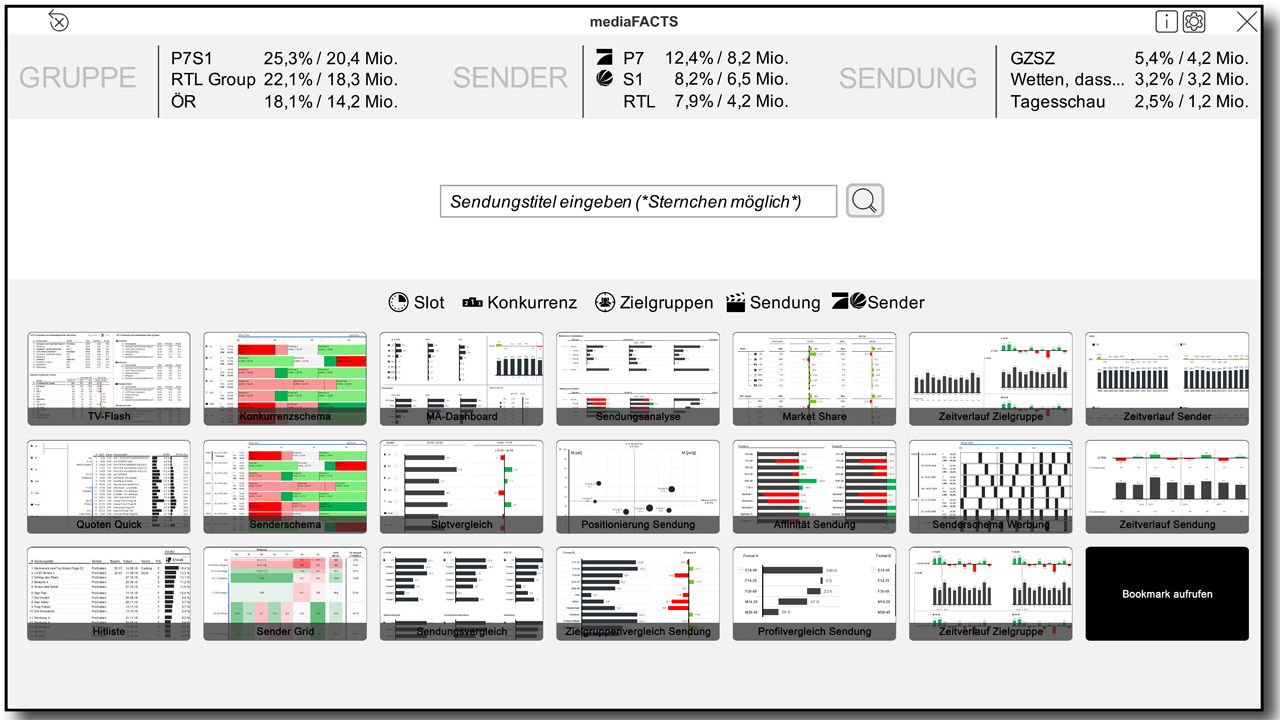
ProSiebenSat.1mediaFACTS landing page Users enter mediaFACTS and the reports via the landing page shown here. A highlighting function allows them to mark those reports that are suitable for their current analytical questions. The reports are clustered into specific topical families such as slot, channel or competitor analyses.
-
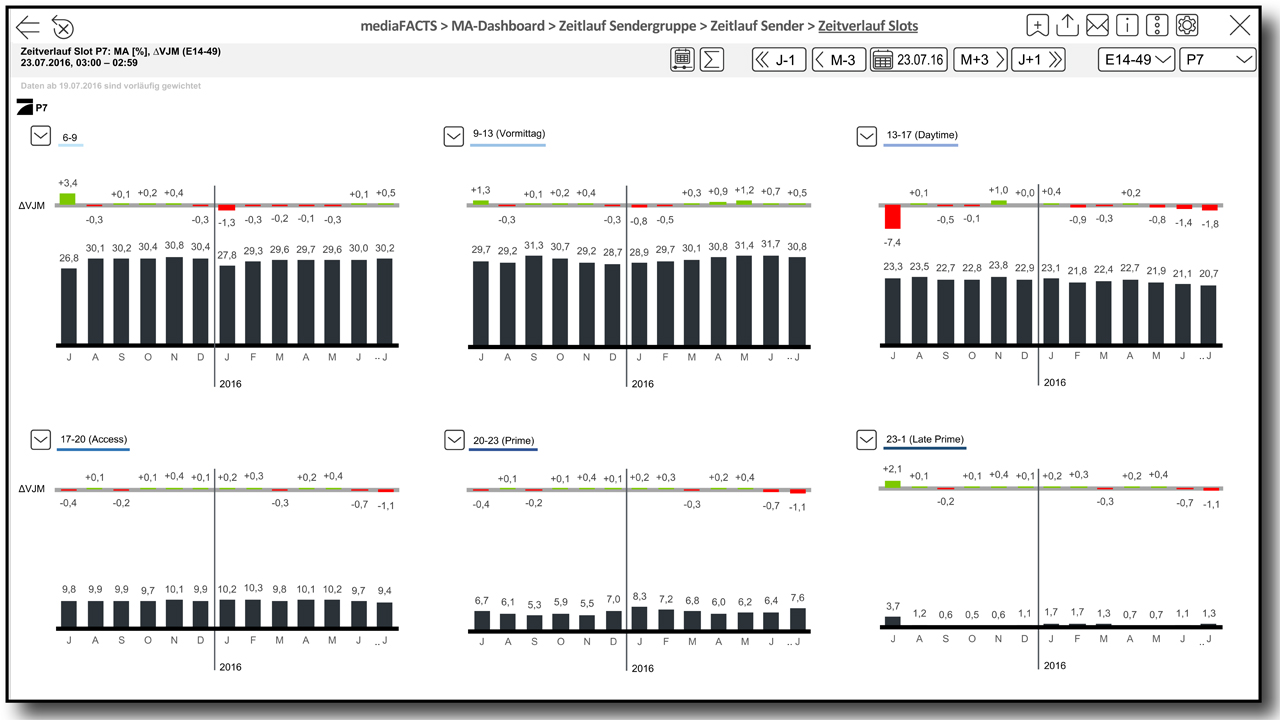
ProSiebenSat.1 mediaFACTS slot analysis This report shows a slot analysis for the channel ProSieben. For a pre-selected target group (here adults between 14-49 years), users can visually compare the market shares of a channel in six time slots. Frequently used functions such as time jumps of 1 year or 3 months into the past can be carried out with a single click using the "quick jumps" offered next to the date menu.
-
ProSiebenSat.1 mediaFACTS structural comparison Users can use this report to make a structural comparison across the entire channel landscape for the current day, month-to-date and year-to-date. The channels are structured hierarchically into channel networks.
-
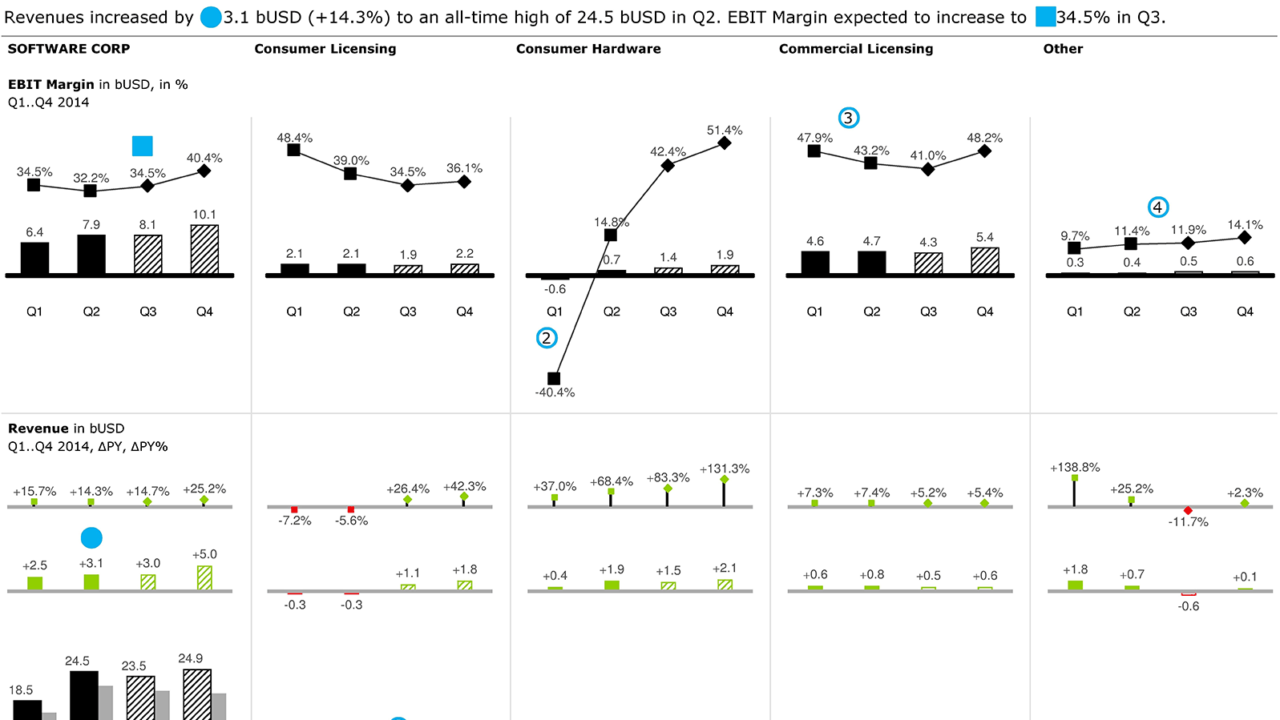
Segment earnings 2014 The EBIT margin and turnover for the company as well as for the four business segments are displayed by quarter. The EBIT margin is shown for both quarters of the year as well as the forecast for the following quarters. The EBIT margin is visualized as a line with the percentage value of the segment revenues in the same chart. The trend in turnover of the company and its business segments is visualized in the charts below. Each of the four quarter values are compared with the value for the previous quarter. The absolute and relative deviations from the previous year are displayed above the charts.
-
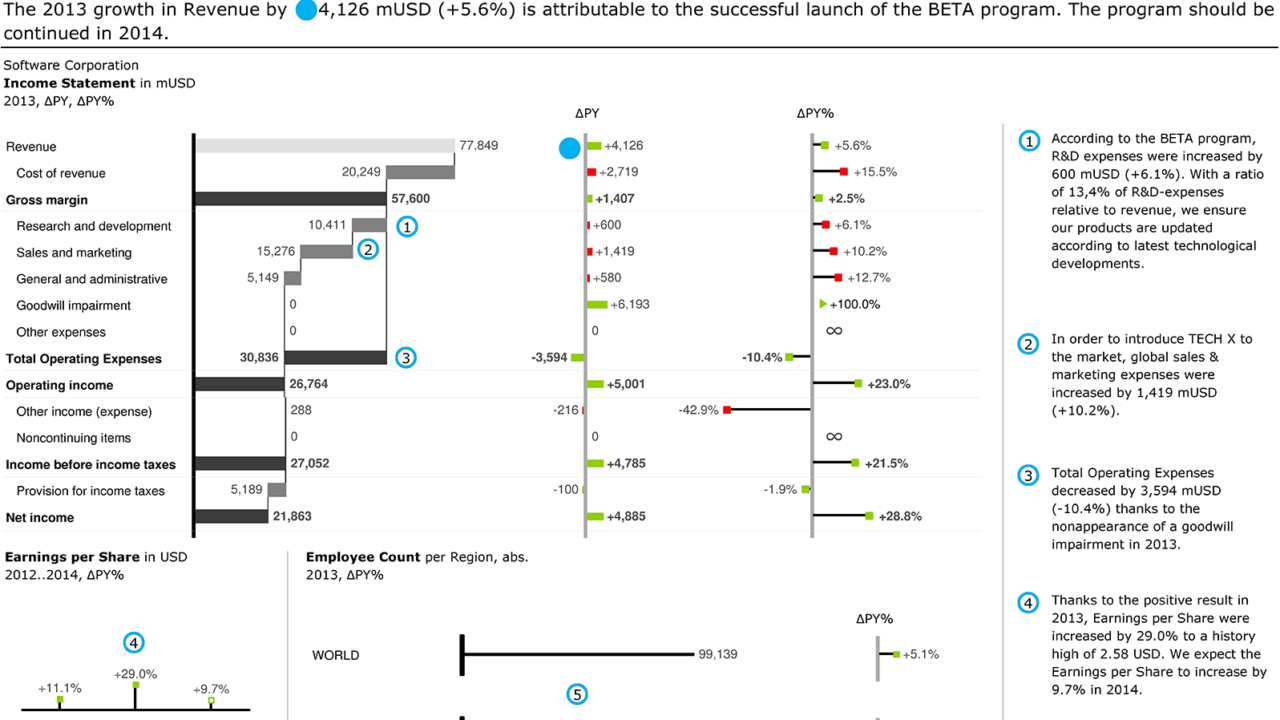
Waterfall income statement 2013 The upper chart is a waterfall chart on the consolidated financial statements. A subtotal is derived from the expenses (Total Operating Expenses). Moreover, the chart shows the absolute and relative deviations from the previous year. The trend in earnings per share for the previous year, the current year, and the budget value for the following year as well as the corresponding percentage deviations are displayed on the left below the waterfall chart. In addition, the viewer also sees the employee count as a total number as well as a value for the individual regions. A pin chart without pin heads is used since this does not involve financial indicators.
-
Book: "Mehr als nur ein Standard" Arne and his team worked together on a scientific study which analyzed the extent to which an IBCS-compliant design of reports facilitates the analysis. The study was carried out in the research laboratory of the TU Munich (the experimenTUM). Here, the participants analyzed different reports on the computers. The study examines both the IBCS as a whole and the individual SUCCESS rules. The complete study (in German) is available on Amazon as paperback and eBook.